
Honey on the road to San Francisco with some of the Spanish explorers
NOTES FROM ABOVE GROUND
By Honey van Blossom

(Honey is a Belgian Marxist former strip-tease artiste)

“Cities of the Golden Gate,” Raymond Dabb Yelland, 1893. Most illustrations can be enlarged by clicking on them.
Prologue to the story of the Spanish exploration and settlement of California
Seasonal migrations of animals now extinct in California probably created the roads the native people used before the Spanish land exploration of California.
“The heyday of giant mammals in North America was the middle and late Pleistocene, an epoch that started 2.6 million years ago and ended 11,700 years ago, around the time the Earth was thawing out from the Ice Age. The gigantic beasts, which migrated from Asia across a now-vanished land bridge called Beringia, are known as Rancholabrean megafauna, after the famous La Brea tar pits in downtown Los Angeles — the graveyard of thousands of saber-toothed tigers, giant bison and other extinct animals.”[1]
The seasonal migrations of the large mammals may have created the substantial roads used by the indigenous people after their arrival.[2]
Paul S. Martin and Richard G. Klein argue that Paleoindian over-hunting led to the extinction of the megafauna.[3] Others argue that climate change was responsible for mammoth and mastodon extinctions. As the last major glaciation ended around 12,000 years ago, climate warmed too quickly for the megafauna to adapt. Read more
Honey tours the San Francisco Presidio
NOTES FROM ABOVE GROUND
By Honey van Blossom
(Honey is a Belgian Marxist former strip-tease artiste)
Juan Bautista de Anza (1736-1788) proposed the site of the San Francisco Presidio on March 28, 1776 at what is today a point near the entrance to the Golden Gate Bridge, near Fort Point.
This is about the location seen in Alfred Hitchcock’s 1957 film Vertigo, when Scottie saves Madeleine from the icy waters of the San Francisco Bay.
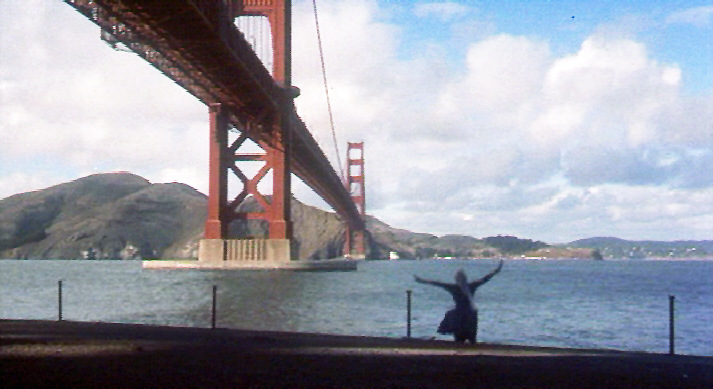
One hundred and eighty one years before Hitchcock made the film, Anza wrote: “I went to the narrowest opening made by the mouth of the port, where nobody had been before. There I set up a cross, and at its foot I buried under the ground a notice of what I have seen…”[1]
The Anza expedition’s diarist Father Pedro Font wrote in his short diary: “Ascending a small hill, we at once entered upon a very bare mesa of great extent, smooth, and inclining a little toward the port. It must be about half a league wide and somewhat longer, and it keeps getting narrower until it ends right at the white cliff. This mesa affords a most delightful view. Indeed, from it one can see a large part of the harbor, its islands, the mouth of the port, and the sea as far as the eye can reach, even beyond the farallones. The commander selected this mesa as the site of the new settlement and fort which was to be established at this port, for, being elevated, it is so commanding that from it the entrance to the mouth of the port can be defended with musket shots…”[2] Read more
Honey and the mystery of El Portezuelo
NOTES FROM ABOVE GROUND
By Honey van Blossom
(Honey is a Belgian Marxist former strip-tease artiste)
[In order to see the detail of the maps and some of the larger photos, you can click on them to see the full size.]
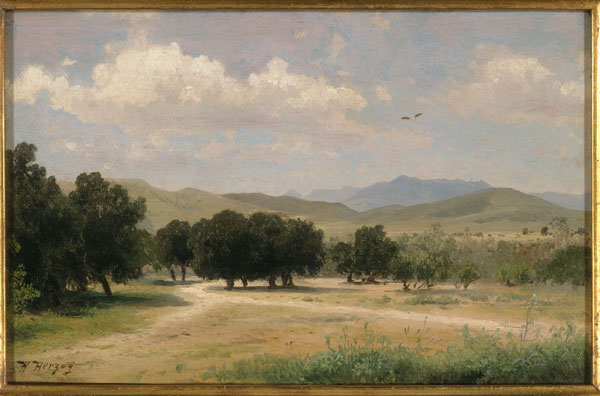
This is an untitled picture, but labeled by the Bancroft library as “a valley near Los Angeles.” It is dated circa 1870. Bancroft Library, the Robert Honeyman, Jr. Collection of Early Californian Art and Western Americana.
[A first part of this study appeared in this column on July 1, titled “Honey’s Search for El Portezuela.”]
A young sailor kept a diary of his voyage on the brig Pilgrim, published as a book in 1840 as Two Years Before the Mast.
The sailor – Richard Henry Dana – arrived in Alta California when it was a province of Mexico, and no longer a Spanish colony. He visited the small city of Los Angeles in 1835.
In his chapter “California and Its Inhabitants,” he wrote, “In the hands of an enterprising people, what a country this might be!”
Dana wrote what most people in the U.S. that had time to think about it believed: the United States should take the Mexican land in Alta California, and eventually, the United States did succeed.
The United States coveted California, even before gold was discovered at Sutter’s Mill. The term “Manifest Destiny,” coined in 1845, expressed an already existing philosophy that drove 19th century U.S. territorial expansion – the United States was destined by God to expand its dominion and spread democracy and capitalism across the entire North American continent. Read more
Honey’s search for El Portezuelo
NOTES FROM ABOVE GROUND
By Honey van Blossom
(Honey is a Belgian Marxist former strip-tease artiste)
[In order to see the detail of the maps and some of the larger photos, you can click on them to see the full size.]
Introduction
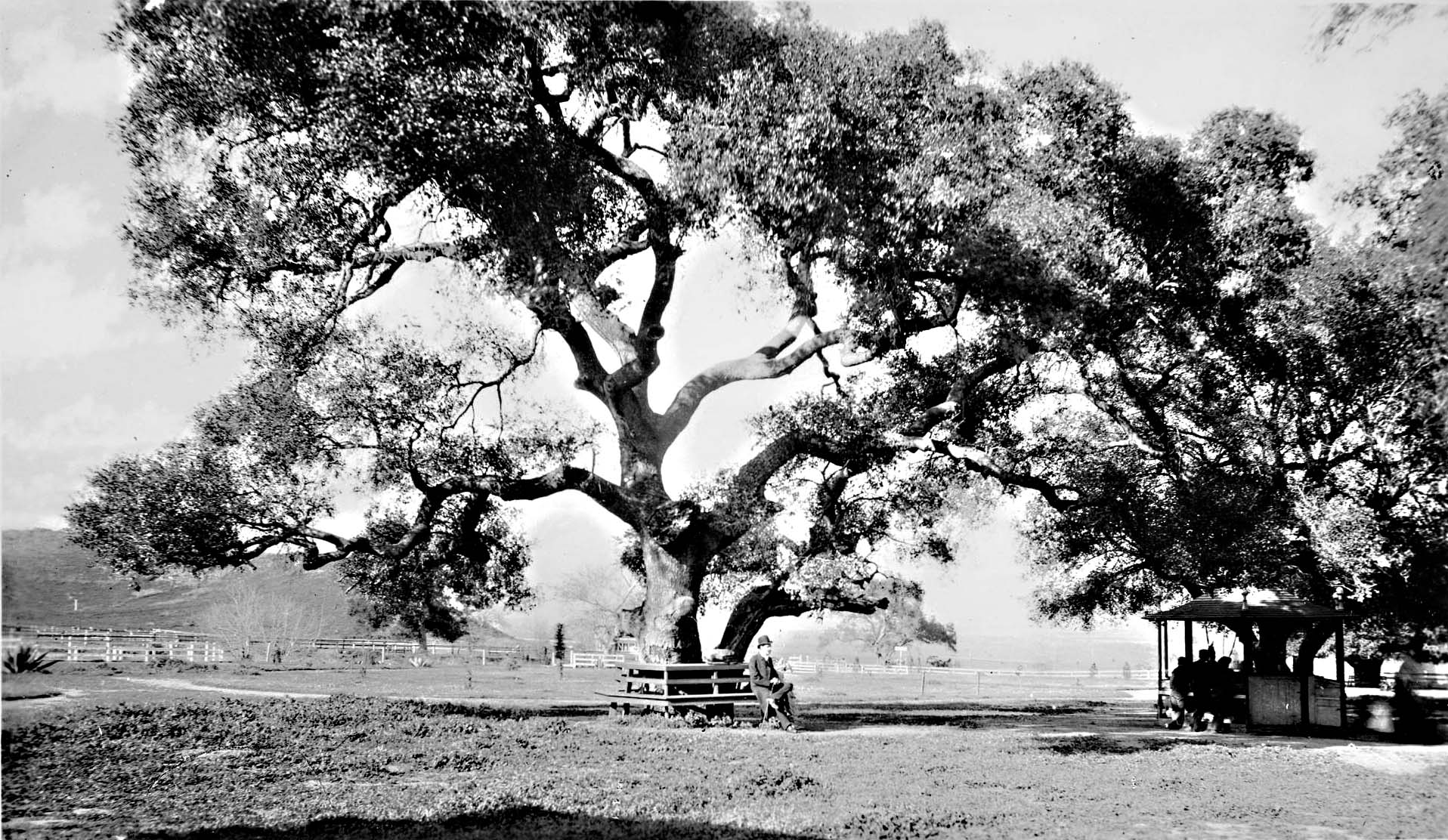
A Huntington Digital Library cataloger wrote that the scene in the photograph of a man sitting under the boughs of a tree was taken at the Ostrich Farm in Griffith Park.
According to Mike Eberts, Griffith J. Griffith’s Ostrich Farm was located near today’s Crystal Springs picnic area.[1]
Mike Eberts was right. The Huntington cataloger was wrong.
The Man Sitting Under Tree Boughs photo shows Beacon Hill, the eastern-most summit in the Santa Monica Mountain Range, the 1,001-foot hill that towers over the Los Angeles River. Beacon Hill separates Crystal Springs from the Riverside Drive portion of Griffith Park.
You can see Beacon Hill from the Crystal Springs side but the hill does not look the same from the Crystal Springs side. Read more
Honey travels through portals of time
Introduction to the portals
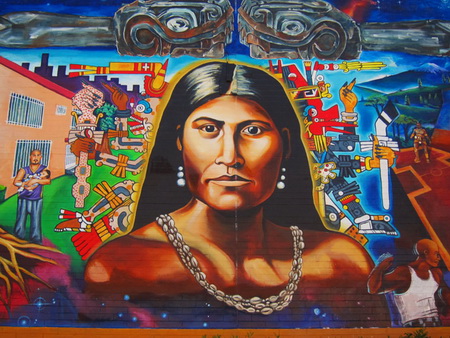
Figure 1: Toypurina mural, Ramona Garden
The people who lived in Los Angeles when it was part of the Spanish empire and during the years Mexico governed it often appear in history books as two-dimensional: cardboard men in sombreros riding pretend horses fitted with painted silver decorated saddles and paper cut out dark eyed women with high combs that lift masses of hair veiled with lace mantillas. They speak pure Castilian Spanish.
This is a cartoon image of the Pastoral Era after secularization of the missions, largely inspired by a “boomer” subsidized by Southern Pacific Railroad to increase the number of passengers on trains to Los Angeles.
The forty-four people that walked from the Mission San Gabriel in 1781 are silent. Read more
Honey does Dogtown
NOTES FROM ABOVE GROUND
By Honey van Blossom
(Honey is a Belgian Marxist former strip-tease artiste)
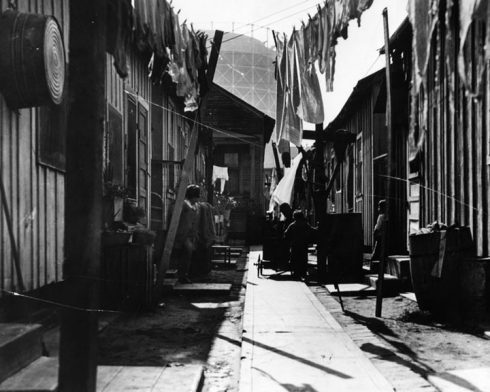
Dogtown. Courtesy Los Angeles Public Library
The history of Dogtown is not a cooperative subject. Its past is scattered through libraries and archives and some of it may be in library basements. Internet and the linked-in library lending system allows some of these sometimes gleaming fragments to be excavated. Information gleaned from books that were based on unintentional misreadings of history and from librarians’incorrect dating and location of information challenge anyone’s attempt to sequence what happened in Dogtown.
Dogtown’s history tells us several stories.
One story is that — after the arrival of the Southern Pacific Railway to Los Angeles — rich farm land along a beautiful river was gradually turned into what today looks an industrial wasteland from a Philip K. Dick novel set on the banks of a ghost river crowded with weird non-native plants, plastic bags hooked on those plants thrown from cars, treated sewage, non-treated street waste, industrial effluent and graffiti. Read more
Honey and the second barrio of Los Angeles
NOTES FROM ABOVE GROUND
By Honey van Blossom
(Honey is a Belgian Marxist former strip-tease artiste)
As soon as a piece of a puzzle does not fit, then the rest of the pieces jiggle and come loose. Some pieces of the history of early Los Angeles jiggle.
William David Estrada, presently Curator of California and American History at the Los Angeles Natural History Museum, wrote that La Placita was built between 1818-1822 on the plaza’s third site; that is, that the settlers or the government moved the plaza from the original site to another site to the Olvera Street location.[1]
That statement is one of the few about the history of early Los Angeles that makes a lot of sense. The Spanish Colonial records were destroyed, H. H. Bancroft’s team of researchers did a tremendous job of copying and attempting to organize – they did not organize all that well; it is hard to this day to understand the organization but Thomas Savage and his assistants spent two years with paper anarchy. There was no survey of Los Angeles until 1849 and no map since about 1793. No one had a deed to his property. Property descriptions were impossible to understand because they referred to things like the orchard where the cows ate the apples. Later writers turned information on its head and because they saw things through preconception and wearing American blinders, they mystified by the beginning of Los Angeles.
That Dr. Estrada figured out there was a second barrio after the original plaza and its surrounding buildings and before there was the plaza in front of the Catholic church near Olvera Street is impressive. Read more
Honey at the Piper Tech
NOTES FROM ABOVE GROUND
By Honey van Blossom
(Honey is a Belgian Marxist former strip-tease artiste)
Behind Union Station and across from the Denny’s stands the C. Erwin Piper Technical Center. C. Erwin Piper died at the age of 84 in 1992. He had been the head of the City’s Public Works Department. I have sat waiting for the bus at the back of Union Station and saw the large building many times and did not notice it, which either sets the bar higher for my obliviousness or says something about the building’s architecture.
The Los Angeles Police Technical Investigation Division is in Piper Tech. The Elections Bureau is in there. A room with boxes no one will let you into is there. There’s a helipad. City Archivist Michael Holland refers to Piper Tech as the city’s junk drawer. Read more
Honey explains the first roads through Los Angeles
NOTES FROM ABOVE GROUND
By Honey van Blossom
(Honey is a Belgian Marxist former strip-tease artiste)
Misperceptions about the role of the aboriginal people of Southern California in building the city begin with the road system, a system possibly 13,000 years old. Understanding the native American road system is a way to reveal that human behavior is not static, that the world of people is not one thing determined by immutable rules, but that it can be – and has been – much different from what it is now.
“In the New World,” wrote Carl Sauer in his 1932 monograph The Road to Cibola, “the routes of great explorations usually have become historic highways and thus has been forged a link connecting the distant past with the modern present. For the explorers followed main trails beaten by many generations of Indian travel.” Read more
Honey once again walks through time to the site of this city’s beginning
NOTES FROM ABOVE GROUND
By Honey van Blossom
(Honey is a Belgian Marxist former strip-tease artiste)
I met Jodi at Nick’s Café on North Spring Street. A statue of a pig stands in front of Nick’s and a pig offering to be devoured is painted on the wall as you come in.
The cafe was once at the edge of the Southern Pacific rail yard, hazardous waste dump and a refinery. The neighborhood gets crappier and grimmer around the back of Nick’s in Dog Town around the William Mead Housing project is. In 1994, polycyclic aromatic hydrocarbons tested at nineteen times the safe level in the housing project. In the City’s general plan, this is the North Industrial District, and by people that live around there sometimes Naud Junction or Mission Junction after two Southern Pacific area junctions. Mission Junction is a little to the north of the old road to the San Gabriel Mission and quite a bit south of the original road to the mission.
North Spring was Toma Road until 1876 when Southern Pacific cut off the top end and the city renamed it. Toma Road went to the Toma. The Toma was the dam and headwaters built out of sticks, stones, reeds and clay that pooled water for the zanja, the irrigation system that sucked out river water and sent it past adobe houses and into the agricultural fields. The Los Angeles State Historic Park aka The Cornfield is on the other side of North Spring Street. Read more
Honey on the road to San Francisco with some of the Spanish explorers
NOTES FROM ABOVE GROUND
By Honey van Blossom
(Honey is a Belgian Marxist former strip-tease artiste)

"Cities of the Golden Gate," Raymond Dabb Yelland, 1893. Most illustrations can be enlarged by clicking on them.
Prologue to the story of the Spanish exploration and settlement of California
Seasonal migrations of animals now extinct in California probably created the roads the native people used before the Spanish land exploration of California. “The heyday of giant mammals in North America was the middle and late Pleistocene, an epoch that started 2.6 million years ago and ended 11,700 years ago, around the time the Earth was thawing out from the Ice Age. The gigantic beasts, which migrated from Asia across a now-vanished land bridge called Beringia, are known as Rancholabrean megafauna, after the famous La Brea tar pits in downtown Los Angeles — the graveyard of thousands of saber-toothed tigers, giant bison and other extinct animals.”[1]
The seasonal migrations of the large mammals may have created the substantial roads used by the indigenous people after their arrival.[2]
Paul S. Martin and Richard G. Klein argue that Paleoindian over-hunting led to the extinction of the megafauna.[3] Others argue that climate change was responsible for mammoth and mastodon extinctions. As the last major glaciation ended around 12,000 years ago, climate warmed too quickly for the megafauna to adapt.
